Organic Mattresses · A Materials Guide
What to Look for in a Naturepedic Organic Mattress
A mattress is a quiet assembly of decisions: what goes inside, what touches the sleeper, how the layers are joined, and what the maker is willing to say about each one. Naturepedic offers a useful starting point for exploring those questions. The aim is not to assume that a familiar word such as “organic” settles them, but to learn how to read the materials, construction notes, comfort options, and care guidance with care.
Begin with the materials, not the adjective
“Organic” has become a reassuring word in the bedroom. It suggests fields instead of factories, fresh air instead of a chemical smell, and a clear line between the natural world and the objects we bring indoors. Yet an organic mattress is not a single material or a single construction. It is a layered product, and different layers may have different compositions, origins, and certifications.
When reviewing a Naturepedic model—or any organic mattress—start with the materials list. Look for the named components in the comfort layer, support core, cover, and any fire barrier. If a description says “natural comfort layer,” ask what that phrase means in practical terms. Is the layer made from latex, cotton, wool, or a blend? Is the support core made from the same material, or something else? Clear descriptions make these distinctions legible; vague ones leave the reader to supply the details.
Materials do different jobs. A comfort layer cushions the body and affects the initial feel. The support core contributes to the mattress’s underlying firmness and structure. A cover encloses the assembly, while a fire barrier is designed to meet applicable flammability requirements. A mattress may also include quilting, adhesives, or other components. A useful product description names these parts rather than treating the mattress as an undivided block.
Naturepedic is a reference point for examining this kind of disclosure, not a substitute for examining an individual model. Product lines can differ, and materials, construction, and available options may vary by model or change over time. Read the current description for the exact mattress you are considering, and consult the manufacturer’s technical information when a detail matters to your decision.
Learn the vocabulary of mattress layers
Cotton and wool
Cotton is often used in mattress covers or quilting. It can offer a familiar, breathable textile surface, though its feel depends on how it is woven, quilted, and combined with other materials. Wool may appear in quilting or as part of a fire-barrier system. It is valued for its natural crimp and capacity to manage moisture, but the presence of wool alone does not tell you how thick a layer is, where it sits, or how the whole mattress will feel.
For either fiber, look past the name to the construction. Is the fiber certified organic? Does the description identify it as a cover material, a comfort layer, or a component of another system? Are percentages or weights given? Those details help distinguish a substantial part of the design from a small, secondary element.
Latex
Latex is a resilient material used in some mattress comfort layers and cores. A listing may identify natural latex, organic latex, or a blend; these terms are not interchangeable, and a clear description should explain the material and its certification status. The word “latex” by itself also does not specify the feel. Thickness, density, firmness, and placement all influence how a layer responds under the body.
If a mattress includes latex, check whether the maker provides information about the layer’s origin and standards. Ask how the latex is used in the mattress, whether it is part of the comfort system or the support structure, and whether the model offers different firmness configurations. A familiar material name is useful, but it is only the beginning of the comparison.
Support materials and construction
A mattress’s support system can be as important as its surface layers. Some designs rely on a foam core; others use different internal constructions. Find out what the specific model uses and how the support layer relates to its comfort layers. If a product page explains only the outer cover and a headline material, look for a detailed specification sheet or ask the manufacturer for a complete layer breakdown.
Also note whether the mattress is one-sided or designed to be turned, whether it has designated head and foot ends, and what the maker says about rotation. These are not glamorous details, but they affect how the mattress is set up and maintained. A construction diagram, when available, can make it much easier to understand what the prose describes.
Certifications: what the label can—and cannot—tell you
Certification marks can help verify particular claims, but no single badge answers every question about a mattress. Some standards concern the organic status of fibers or other agricultural materials. Others address emissions, chemical restrictions, or testing of finished products. The scope of a standard matters: a certificate may apply to a material, a component, a facility, or a finished product, and those are not necessarily the same thing.
When a product description mentions a certification, look for the name of the standard and the precise item or component it covers. Check whether the manufacturer provides a certificate number, an explanation of the claim, or a link to the certifying organization’s directory. If the label is described only in broad promotional language, it is reasonable to ask for clarification. The most useful certification information is specific enough to be checked independently.
It is also important to distinguish “natural” from “organic.” Natural is a broad description, not by itself a verification system. Organic claims have defined requirements when they are covered by a recognized certification, but an organic fiber in one part of a mattress does not automatically make every other component organic. The full materials list and the scope of any certification should be read together.
Certifications do not measure comfort, durability, or personal suitability. A mattress can satisfy a meaningful environmental or emissions standard and still feel too firm, too soft, or too warm for a particular sleeper. Conversely, a comfortable feel does not establish the material’s origin. Treat certifications as evidence about specific claims, then evaluate comfort and construction on their own terms.
Comfort is a relationship, not a number
Firmness labels are useful shorthand, but they are not a universal scale. A “medium” mattress from one maker may feel different from a “medium” mattress elsewhere, and the same model can feel different to people with different body shapes, sleep positions, or preferences. The effect of a mattress also depends on its foundation, pillow, and bedding. A label can orient you; it cannot complete the fitting.
Think first about how you sleep. Side sleepers often pay particular attention to cushioning at the shoulder and hip, while back sleepers may focus on a balance between contouring and support. Stomach sleepers may prefer a surface that does not allow the midsection to sink excessively. These are starting points rather than rules, and comfort remains individual. If you share a bed, each person’s needs—and any motion they notice from the other—belong in the comparison.
Look for the actual comfort choices available for a particular Naturepedic model. Does it come in more than one firmness? Are the options created by changing a layer, or by offering separate versions? Can components be adjusted or replaced? Do not assume that every option is available across every model or size. Confirm the current choices and the terms under which they are offered.
Whenever possible, test a mattress in the position in which you normally sleep. Give yourself time to settle rather than judging by the first few seconds of lying down. If you cannot try it in person, carefully read the trial, return, exchange, and warranty terms before ordering. Pay attention to time limits, required foundations, return fees, and any condition requirements. These policies can affect the practical risk of choosing a mattress online.
Temperature, moisture, and the rest of the bed
Temperature regulation is often discussed as if it were a property of one material. In practice, the experience of warmth or coolness comes from the mattress, the sleeper, the room, the sheets, the duvet, and the movement of air around the bed. A breathable cover may contribute to a more comfortable surface, but it cannot guarantee that a sleeper will feel cool. Similarly, natural fibers may influence moisture handling without making every mattress suitable for every climate.
Consider the layers you already use. Crisp cotton percale sheets, a wool blanket, a thick mattress protector, and a heavy comforter each change the feel of the sleep system. If you are comparing mattresses, try to keep those surrounding factors consistent. Otherwise, it can be hard to tell whether a difference comes from the mattress or from the new bedding placed on top of it.
Protectors deserve particular attention. They can help guard against stains and everyday wear, but their fabrics and construction may change the surface feel or airflow. Check the mattress maker’s recommendations and warranty conditions before choosing one. A protector that fits poorly, traps heat, or is incompatible with the care instructions may undermine the experience you are trying to preserve.
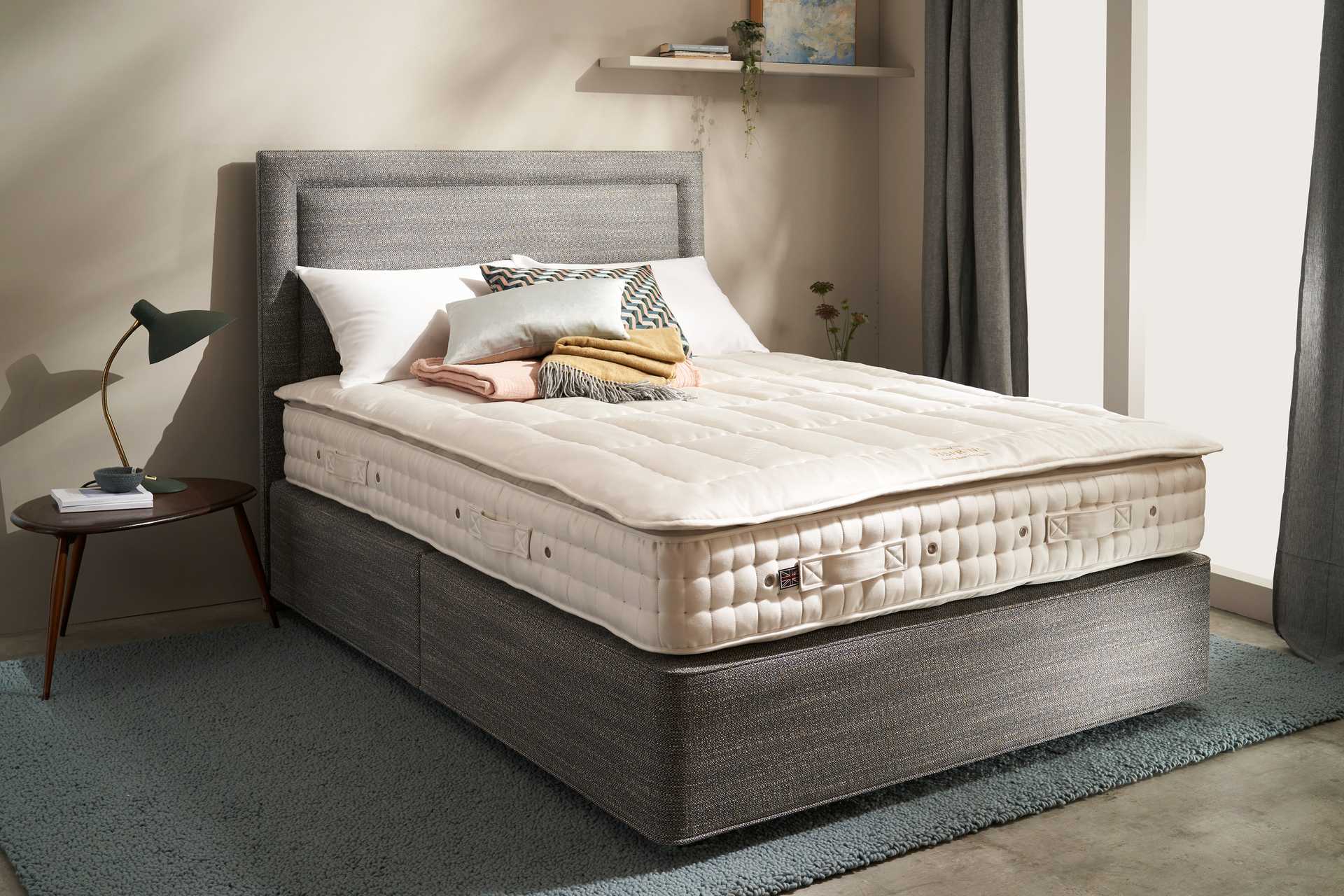
In a home shaped by classic furnishings, a mattress’s hidden materials may seem separate from the visible room. They are not entirely separate. The bed is both a place to sleep and a large piece of the bedroom’s architecture. A low-profile frame, traditional wooden bed, or high foundation can alter the finished height, proportions, and ease of getting in and out. Measure the frame and bedding together, and consider whether the new mattress will sit comfortably within the room’s existing arrangement.
Care guidance is part of the purchase
A well-described mattress should come with practical advice about setup and care. Before buying, find out how the mattress should be carried, unwrapped, aired, and placed on its foundation. Some mattresses are heavy or difficult to maneuver; delivery and installation arrangements can therefore matter as much as the material list, especially in older homes with narrow stairs or tight turns.
Read the cleaning instructions before an accident occurs. Mattress care generally calls for measured intervention: follow the maker’s directions for spot cleaning, avoid unapproved cleaners, and do not soak layers that cannot dry thoroughly. Ask whether the cover is removable and washable rather than assuming that a zipper means it should be laundered. A removable cover may be intended for manufacturing or inspection purposes, not routine home washing.
Rotation instructions vary by construction. Some mattresses should be rotated at intervals; others may have a designated orientation or should not be flipped. Follow the directions for the model rather than applying a universal rule. Keep purchase documents, warranty details, and care instructions where they can be found later. A mattress is an object that works quietly for years; its paperwork tends to be needed precisely when it has disappeared into a drawer.
A practical way to compare models
Comparing organic mattresses can become a contest of adjectives: pure, clean, natural, cloudlike. A short checklist brings the decision back to evidence. For each model, record the following:
- Materials: What is used in the cover, comfort layers, support core, quilting, and fire barrier?
- Layer details: Are thickness, density, fiber content, or construction described clearly?
- Certifications: Which standard applies, and does it cover a component or the finished mattress?
- Comfort: What firmness choices exist, and how are they defined for this model?
- Fit: Is the mattress compatible with your frame or foundation, and does the finished height suit your needs?
- Care: What are the cleaning, rotation, and protection instructions?
- Policies: What are the trial, return, exchange, warranty, and delivery terms?
- Disclosure: Can you find answers to these questions in current product information or obtain them directly from the maker?
This method makes Naturepedic a useful point of comparison without turning the exercise into a verdict based on brand name alone. Compare like with like: the same mattress size, a similar firmness, and equivalent descriptions of the layers. If one company provides unusually detailed specifications and another uses only general language, that difference is itself worth noting.
Keep a record of questions that remain unanswered. Ask the manufacturer about a material’s composition, the scope of a certification, the foundation requirements, or the permitted cleaning method. A direct answer should be clear and consistent with the published product information. If the response is difficult to interpret, request the relevant documentation rather than relying on an impression.
Common reading mistakes
One mistake is assuming that a mattress is entirely organic because one material is certified organic. Another is treating a certification as a guarantee of comfort or medical benefit. A third is comparing firmness descriptions across brands as though they were standardized measurements. Each shortcut replaces a question with an assumption.
It is also easy to mistake a detailed materials list for a complete account of performance. Materials tell you what is present, but construction tells you how those materials are arranged. Two mattresses may use similar fibers and still feel quite different because their layer thicknesses, densities, or internal designs are not the same. Conversely, attractive language about a particular fiber does not explain how much of it the mattress contains or what job it performs.
Finally, do not let the desire for an idealized “natural” bedroom obscure the practical questions. A mattress must fit the body, the room, the frame, the budget, and the routines of the household. A useful guide is not one that promises a perfect object; it is one that helps you recognize what is known, what remains uncertain, and which uncertainties matter to you.
The well-made question
The most revealing question about an organic mattress is not simply, “Is it natural?” It is more specific: What is each layer made of, what role does it play, how is the claim verified, and how will the mattress be cared for over time? Those questions reward patient reading. They also make it easier to compare a Naturepedic mattress with other options without confusing a brand’s identity with the details of a particular model.
In the end, a mattress is both material fact and intimate experience. Its fibers and certifications can be documented; its feel must be discovered by the person who sleeps on it. Read the specifications, examine the construction, verify the scope of the claims, and take the comfort and care policies seriously. Then choose not the mattress with the most persuasive vocabulary, but the one whose information is clear and whose design makes sense for the way you live.