Pillows · A practical guide
How to Choose a Down Pillow for Your Sleep Position
The right down pillow is less a cloud than a small piece of engineering: soft enough to yield, structured enough to keep the head and neck in a comfortable line. Loft, fill, and construction matter—and so does the way you sleep.
A down pillow has a talent for making the first impression. It looks generous, feels inviting, and compresses beneath a hand with the pleasing ease of something that has not yet been asked to do any work. The more consequential question comes later, after the lights are out: Does it keep the head comfortably supported, or does it collapse into a soft suggestion of a pillow?
That distinction is why choosing a down pillow is not simply a matter of choosing the plushest option. Sleep position changes the space a pillow needs to fill. A side sleeper generally needs more height than someone who sleeps on their stomach; a back sleeper often falls somewhere between. But body shape, mattress softness, personal preference, and the pillow’s ability to compress all complicate the tidy categories.
Understanding a few terms—loft, fill power, fill weight, firmness, and construction—can make a crowded field of down pillows easier to navigate. They describe different things, and none, on its own, guarantees comfort. The useful question is not whether a pillow is objectively soft or lofty. It is whether it settles into a supportive shape for you, in your usual position, night after night.
Start with the space your pillow needs to fill
A pillow’s job is to support the head while allowing the neck to remain in a comfortable, fairly neutral alignment with the rest of the spine. It should fill the gap between the head and mattress without forcing the chin toward the chest or tipping it upward. In practice, that gap varies. A broad-shouldered side sleeper on a firm mattress may need a different loft from a narrower person on a deeply cushioned surface, even if both prefer to sleep on their sides.
Loft is the pillow’s height when it is resting in its natural state. Working loft is what remains after the head has compressed it. The distinction matters especially with down, which is prized for its ability to compress and recover. A pillow that looks tall on a bed may settle considerably under weight. Conversely, a thoughtfully constructed pillow may begin with a modest profile but maintain more useful support once in use.
Try to assess the pillow as it behaves, rather than judging it by appearance alone. If testing in person is possible, lie down in your ordinary position for several minutes. Let your shoulders relax. Notice whether your head is supported without strain and whether you feel a pull at the back or side of your neck. A quick squeeze in a showroom tells you something about softness; it tells you rather less about a full night’s support.
The side sleeper: height and structure
When you sleep on your side, the shoulder creates a wider space between your head and the mattress. A pillow that is too low can let the head angle downward; one that is excessively high may bend the neck in the other direction. Many side sleepers therefore find a medium-high or high-loft pillow more comfortable, though “high” is relative to the person, the mattress, and how readily the fill compresses.
Down pillows can be appealing to side sleepers because they are moldable. You can fluff the fill, shift it toward the area that needs more support, or shape the pillow around the head. Yet an especially soft, loosely filled pillow may flatten under sustained pressure. If you prefer down’s light, yielding feel but want a steadier center, look for details that suggest greater structure: a firmer fill option, a gusseted edge, or an inner chamber designed to resist flattening.
A gusset is a band sewn around the pillow’s perimeter, giving it a deeper, more uniform profile than a simple flat seam. It can help the pillow maintain its shape at the edges. It does not automatically make a pillow suitable for every side sleeper, but it is one construction detail worth considering when a flat pillow seems to disappear beneath your head.
Give particular attention to the pillow’s compressed height. If your shoulder is broad, your mattress is firm, or you tend to tuck a hand beneath the pillow, a little additional loft may be useful. If the mattress allows your shoulder to sink deeply, you may need less. The aim is support that feels steady without making the head seem perched above the body.
The back sleeper: a middle course
Back sleepers often do best with a medium loft: enough to support the natural curve at the neck, but not so much that it pushes the head forward. A very high pillow can make the chin tilt toward the chest; a very low one may leave the neck feeling under-supported. The right balance is subtle, and it may take a few nights to distinguish a pillow that feels pleasantly plush from one that holds a comfortable position through the night.
Fill amount and firmness can help determine that balance. A medium-fill down pillow tends to offer a compromise between easy compression and a more persistent cushion. Some sleepers like to shape the pillow slightly beneath the neck, leaving a shallow hollow for the head. That ability to arrange the fill is part of down’s appeal, but it should not require constant reworking. If you have to punch and fold the pillow repeatedly to make it comfortable, its loft or construction may not suit you.
Back sleepers who move between their back and side should consider the position they spend the greatest part of the night in, while allowing for the others. A pillow chosen only for the first position in which you fall asleep may feel wrong by morning. In that case, a responsive, adjustable-feeling pillow can be more forgiving than one with a rigid, fixed profile.
The stomach sleeper: less height, less resistance
Stomach sleepers usually need a low-loft pillow, or sometimes no pillow beneath the head. A thick, buoyant pillow can turn the neck sharply to one side and create an uncomfortable angle. A soft down pillow may work because it compresses readily, but softness alone is not enough: if the pillow retains too much height under the head, it can still feel intrusive.
Look for a soft or low-profile option and consider how much fill is inside. A pillow can be soft to the touch yet remain too full once it is compressed. If you are a combination sleeper who spends part of the night on your stomach, a pillow that can be shaped or gently redistributed may be more practical than one with a fixed, high loft.
Comfort is individual, and sleep-position advice is a starting point, not a prescription. Persistent pain, numbness, or discomfort deserves more than a bedding adjustment; a qualified health professional can help assess the cause. But for ordinary pillow shopping, the basic test is straightforward: your pillow should not force your head into an angle that feels strained.
Down, feathers, and blends: what is inside?
Down consists of the soft clusters found beneath the outer feathers of waterfowl. Its fine, three-dimensional structure traps air, creating warmth and loft without the weight of a dense filling. Feathers have a more defined structure and can contribute resilience and firmness. A blend combines qualities of both: depending on its proportions and construction, it may feel more substantial than a pillow filled only with down.
These terms describe material, not a guaranteed level of comfort. Two pillows labeled “down” can feel quite different because they use different fill amounts, cluster sizes, chamber designs, and shell fabrics. Nor does the word “feather” tell you exactly how firm a pillow will feel. The proportions, distribution, and way the pillow is sewn all influence its behavior.
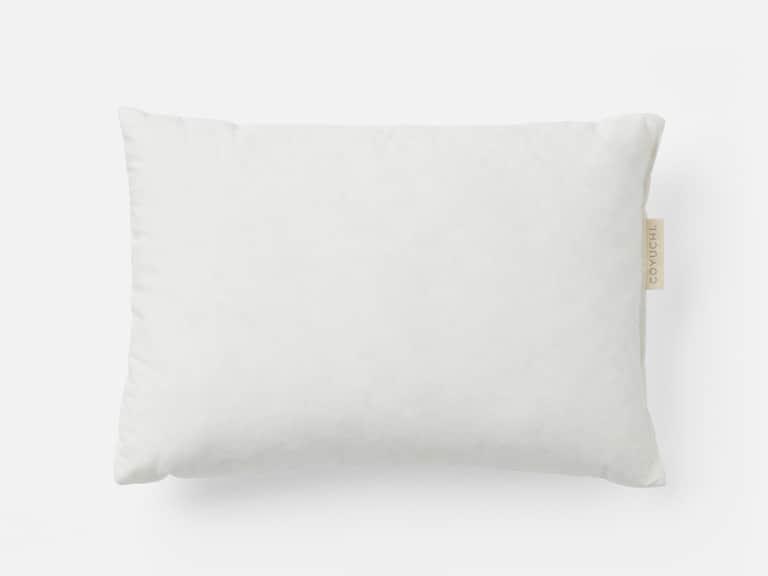
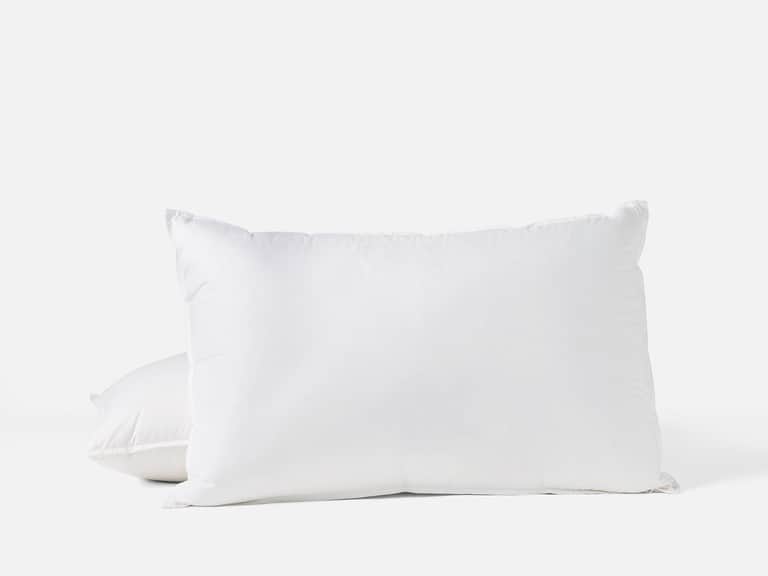
Some designs use separate chambers to give the pillow a structured center and softer outer layers. For example, the Goose Down Feather Pillow uses a three-chamber construction: an inner chamber filled with white goose feathers, surrounded by outer chambers containing a down-and-feather blend. Its organic cotton shell and layered fill are designed to combine a more supportive center with softness at the surface. That construction may interest sleepers who like a cushioned feel but do not want the entire pillow to behave as one uniformly soft mass.
It is best to treat a product description as a set of clues, then match those clues to your own preferences. A chambered pillow may feel more structured than a single-compartment pillow, but the final experience still depends on its dimensions, fill quantity, and how much it compresses under your head.
Fill power is not firmness
Fill power is often prominent in descriptions of down bedding. It measures the volume occupied by a given weight of down under standardized conditions, and offers an indication of loft and insulating capacity. Higher fill power generally means that the down can create more volume for its weight. It does not, by itself, tell you whether a pillow will feel soft, medium, or firm.
That distinction is easy to miss. A high fill-power pillow might feel lofty and light, but its firmness also depends on how much fill is used, the size and nature of the pillow, and whether it has a gusset or chambers. A lower fill-power pillow can feel quite firm if it contains a comparatively large amount of filling. If you are comparing options, look for firmness descriptions, fill weight, and construction alongside fill power rather than treating one number as a verdict.
Fill weight—the actual quantity of filling in a pillow—can be useful for comparisons, particularly when size and design are similar. It is not a perfect measure either. A larger pillow naturally requires more fill, and the same weight can behave differently in different constructions. Read specifications as a whole: material blend, size, fill weight, loft, firmness, and sewing details belong in the same conversation.
The cover is part of the pillow
A pillow’s shell does more than keep the filling in place. A tightly woven, down-proof fabric helps prevent fine fill from escaping through the weave. Cotton is commonly used because it can feel breathable and comfortable against the skin. Thread count may appear on a label, but it should not be mistaken for a complete measure of quality: weave, fiber, finishing, and construction also matter.
The cover affects how the pillow feels before the fill has a chance to make its case. A crisp, firm shell can make a pillow seem more substantial; a supple fabric may allow the fill to shift and mold more freely. A protective pillow cover beneath a pillowcase can help limit exposure to sweat, oils, and dust, reducing how often the pillow itself needs attention.
For people who are sensitive to allergens, it is useful to distinguish between a material’s reputation and the specifics of a particular product. Cleaning processes, protective encasements, and clear care instructions may all be relevant. No fill type is a universal solution for every person’s sensitivities; check product details and, where necessary, seek guidance from a clinician.
A practical way to compare pillows
When shopping, it helps to approach the options with a short list of questions rather than with the vague instruction to find something “comfortable.” Begin with your usual sleep position, then consider whether you prefer a pillow that holds its shape or one that can be rearranged. After that, compare the details that explain how the pillow may achieve that feel.
- What is your primary sleep position? Use it to estimate the loft you may need, then account for the time you spend in other positions.
- How much does the pillow compress? A tall pillow can become low under weight, while a modest-looking pillow may retain a useful profile.
- What is the fill composition? Down, feather, and blends offer different combinations of softness, resilience, and structure.
- How is the pillow constructed? Gussets and separate chambers can affect shape and support; they are meaningful details, not mere decoration.
- What do the care instructions allow? Washing and drying requirements differ. Follow the manufacturer’s guidance, especially for products with natural fill.
- Can you test it, or return it? A sleep trial or clear return policy can make it easier to judge the pillow in your own bed, where its performance matters.
When trying a pillow, settle into your normal position instead of propping yourself upright. Give the fill time to compress. Notice whether you feel comfortable at the neck, whether the pillow stays in place as you relax, and whether you instinctively fold or bunch it. Those small habits are useful information: they may mean you want a different loft, more structure, or a pillow that is easier to shape.
Care and longevity
Down pillows need some airing and occasional fluffing to recover their loft. A pillow protector can reduce everyday soil, while a pillowcase provides the familiar, washable outer layer. Before laundering, read the care label closely. Some pillows can be machine washed on a gentle cycle; others require particular equipment or professional care. A pillow that is not dried thoroughly can retain moisture in its filling, so drying instructions deserve as much attention as washing instructions.
Over time, even a well-made pillow can lose resilience, develop persistent clumps, or stop returning to a supportive shape. A simple check is to fluff it and observe whether it recovers. If it remains flat, lumpy, or uncomfortable despite care, it may no longer be doing its job. The calendar can offer a reminder, but condition and comfort are better guides than an arbitrary replacement date.
The pillow that suits the sleeper, not the label
Shopping for a down pillow often invites a search for the most luxurious specification: the highest fill power, the most elaborate chamber, the softest shell. Yet a pillow’s usefulness is less theatrical. It is the quiet matter of whether its height remains appropriate when compressed, whether its fill provides the resistance you like, and whether your head and neck feel at ease in the position you actually occupy.
For side sleepers, that may mean enough loft to fill the shoulder-to-head gap and enough structure to resist flattening. Back sleepers often look for a moderate height that supports without pushing the head forward. Stomach sleepers commonly benefit from a lower, softer profile. In each case, softness is only one quality among several, and a product description is a map rather than the territory.
Compare fill and construction, pay attention to the shell and care requirements, and be honest about how you sleep. A good pillow need not announce itself. It simply makes the space between head and mattress feel settled, then allows the rest of the room—and the night—to recede.